Accounting & Financial Management
Business Registrations
Tax & Regulatory Compliance
Annual Compliance Services
About Company

Index
ToggleThe Unified Payments Interface (UPI) is now the backbone of digital payment ecosystem in India. From small stalls to large businesses, UPI helps low cost, instant and secure financial transactions. As UPI continues to be a trendy, instant, fast and secure way of payment, crossing billions of transactions each month, The RBI and the NPCI have launched updated rules and transaction amount limits for the year 2026.
Here we present a detailed guide that explains the latest transaction limits for UPI in 2026, latest RBI updates, merchant charges, practical tips, compliance requirements as well as bank wise caps for businesses and individuals.
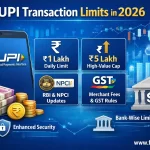
As per the NPCI guidelines, the standard daily UPI transaction limit remains to be ₹1,00,000 for P2P or person to person transactions. But banks have the discretion to even set a lower limit as per their internal risk policies and rules. The typical bank limited range from ₹25,000 to ₹1,00,000 daily with a cap of upto 20 transactions each day.
| Transaction Type | Limit | Notes |
| P2P | ₹1,00,000/day | Max 20 transactions |
| Capital Markets & Insurance | ₹2,00,000/day | Bank-dependent |
| UPI 123Pay (Feature Phones) | ₹10,000/transaction | Designed for non-smartphones |
| UPI Lite Wallet | ₹1,000/transaction | ₹5,000 max wallet balance |
In order to support the high value payments done digitally, the NPCI has also introduced enhanced limit of ₹5,00,000 per transaction for specific uses which will be effective from 15th September 2026.
Transactions Eligible for ₹5,00,000 Limit
These limits are beneficial mainly for the investors, salaried people and businesses that handle large transactions with UPI.
While the NPCI sets the maximum cap, it is actually the banks that define operational limits. Below we present the indicative limits for major banks in 2026:
| Bank | Daily Limit | Weekly Limit | Monthly Limit |
| SBI | ₹1,00,000 | No limit | No limit |
| HDFC Bank | ₹1,00,000 | No limit | No limit |
| ICICI Bank | ₹1,00,000 | No limit | No limit |
| Axis Bank | ₹1,00,000 | No limit | No limit |
| IDFC First Bank | ₹1,00,000 | ₹1,00,000 | ₹30,00,000 |
| Kotak Mahindra Bank | ₹1,00,000 | No limit | No limit |
Note: Limits may vary as per customer risk profile and app settings.
NPCI has also introduced the operational safeguards from 1st August 2026. These are aimed at reducing frauds and thus improving the overall system efficiency.
First-Time User Restrictions
Balance Check Limits
Account Linking Limit
Transaction Status Checks
Auto-Debit Time Rules
Under RBI’s Authentication Mechanisms for Digital Payment Transactions Directions 2025, all UPI transactions now need 2-factor authentication.
Accepted Authentication Factors are:
What This Means?
This will improve the protection against SIM swap and phishing frauds significantly.
UPI remains to be free for the consumers but the merchants have to incur charges for some transactions that involve PPIs (prepaid payment instruments) such as wallets.
Interchange Fees for PPI-Based UPI Payments-
| Merchant Category | Fee Rate |
| Agriculture, Education, Utilities, Fuel | 0.5% |
| Insurance, Government, Railways | 1.0% |
| Retail & Convenience Stores | 1.1% |
Important points to remember:
Wallet Loading Charges
UPI receipts are traceable and will count towards taxable turnover.
GST Registration Thresholds
What practices to follow?
For Individuals
For Merchants
Understanding UPI transactions and limits along with the latest regulations in 2026 is important for maximizing the benefits of digital payment ecosystem. While the daily limit of ₹1,00,000 serves most of the users, there are some categories that provide enhanced limits of ₹5,00,000 for higher value transactions. The latest authentication rules from April 2026 will further strengthen security while the operational rules ensure efficiency of the system.
For the businesses, staying compliant with GST updates and understanding the interchange fee structure is important for proper operations. As UPI evolves with features such as withdrawals and voice payments, merchants and individual users must stay updated about regulatory changes to leverage the payment ecosystem in an effective way.
And as this digital payment ecosystem continue to evolve, staying up to date with the NPCI and RBI guidelines is not just an option, it is essential. For compliance guides, SME focused financial updates and accounting insights, stay connected with Finocircle and get up to date information and support.