
Accounting & Financial Management
Business Registrations
Tax & Regulatory Compliance
Annual Compliance Services
About Company







Have you ever noticed that why do some SMEs always have cash in their banks while other struggle to even pay their salaries, vendors or file GST, despite the fact that they have similar revenue?
The answer is not just about sales alone. It is about the cash flow management, receivable control, banking relationships, funding strategy and forecasting discipline.
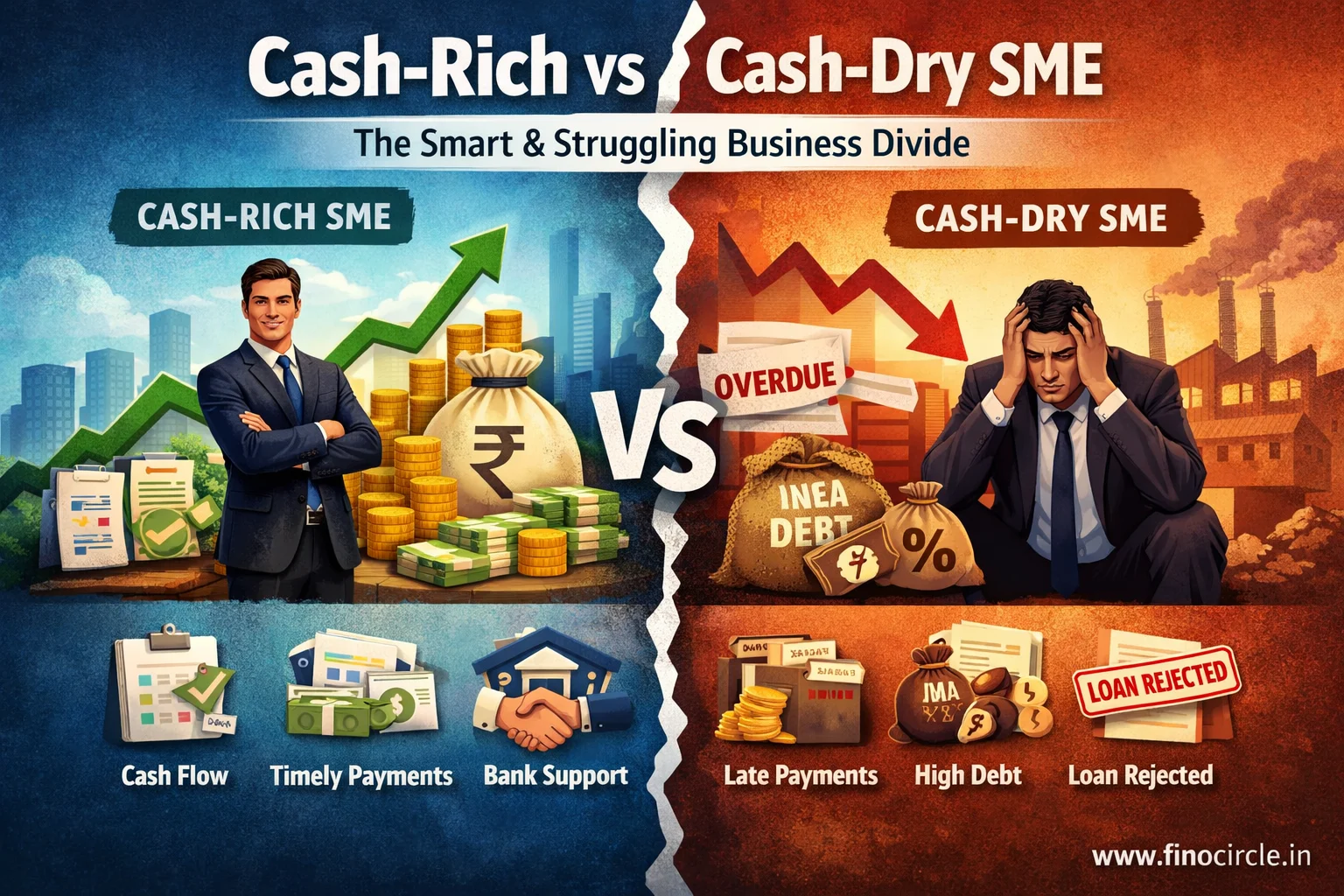
Here we will be comparing two fictional but very realistic Indian SMEs. One that is cash rich and confident and the other that remains cash dry and stressed all the time.
By doing these contrasting case studies, we will also uncover the lessons that Indian SMEs can take immediately and the steps to take to strengthen their finances.
Many SME founders believe:
“If revenue is growing, cash will automatically follow.”
But in reality:
So, one must understand this difference between cash dry and cash rich to know the reason behind businesses that are constantly firefighting vs. scaling confidently.
Business Profile
Even though after having moderate margins, this one never struggles with liquidity problem.
What They Do?
Such companies maintain a rolling 12 months’ cash flow forecast which is also updated each month. They also track the variable outflows (tax, marketing cost, bonuses), fixed outflows (rent, software and salaries) and the expected inflows.
They maintain a 12-month cash flow forecast, updated every month.
They clearly track:
Result:
They see the cash gaps a few months in advance and not at the last moment when the bank balance is zero. This way, cash forecasting helps the founders to take decisions early on.
Such owners follow a tight receivables discipline-
Clear payment terms
Weekly ageing review
Automated invoice reminders
Result: The average collection period is about 38 days, minimal bad debts and predictable monthly inflows.
Such owners do not borrow when they are in trouble, they borrow because it is strategic. CC/OD limits are used as buffer, credit lined are negotiated before they are needed on an urgent basis and short term working capital is used to smoothen out the cash cycles.
Result:
They control cash instead of the other way round- cash controlling them.
These owners treat bank as the financial partner. There is transparent communication, regular sharing of MIS reports and clean books maintained with timely compliance.
Result:
Business Profile
If we see on paper, such businesses look bigger but they struggle with cash all the time.
Where Things Go Wrong?
The founder reviews:
But there is no cash flow forecast.
They don’t know:
Result:
Decisions are sudden and not planned.
Common issues:
Result:
Loans are taken when:
This results in:
From the bank’s perspective:
Result:
| POV | Cash-Rich SME | Cash-Dry SME |
| Cash Flow Forecast | 12-month rolling | None |
| Receivables | Actively monitored | Ignored |
| Borrowing | Strategic | Emergency-driven |
| Banking Relationship | Proactive & transparent | Reactive & strained |
| Stress | Controlled | Constant |
You can show the profits but still be out of cash. It is imperative to track when money comes in.
You need to remember that sales without collection are only future hopes and not liquidity. You should rather have credit policies that are straight and clear and regular ageing reviews.
Borrowing should always support your growth. A simple cash flow forecast can lower the interest costs, improve the negotiation with banks and reduce any unwanted loans.
Banks are seen to be lending more to the businesses that have clean books, communicate well and early on time and share the MIS reports. Having a good banking relationship is built in advance and not at the last moment when you need money.
Finocircle works with startups and SMEs to build cash flow forecasting, strengthen their compliance and banking readiness, create MIS dashboards and improve receivable management. The team’s goal is simple- to help business owners move from cash dryness and anxiety to clarity.
Being cash rich is not just about having good revenue. It is also about systems, financial visibility and discipline. So if your business at any time feels cash dry even after having decent amount and number of sales, the problem can be solved with the right financial structure. Cash doesn’t disappear, you need to remember that it is just stuck somewhere.
