
Accounting & Financial Management
Business Registrations
Tax & Regulatory Compliance
Annual Compliance Services
About Company







The Indian government has officially notified the Income Tax Act 2025 and will come into effect from April 1, 2026. The 6-decade-old Income Tax Act 1961 will be replaced. This move is to simplify direct tax laws in India, digitize compliance, and reduce litigation. While this impacts taxpayers, it also carries implications for LLPs and partnership firms, primarily regarding TDS obligations, reporting norms, and partner remuneration.
The latest law will take effect from FY 2026-27, but Section 194T on TDS for payments to partners has been effective since April 1, 2025. LLPs and firms must prepare in advance for the next year to avoid any penalties, compliance defaults or cash flow disruptions.
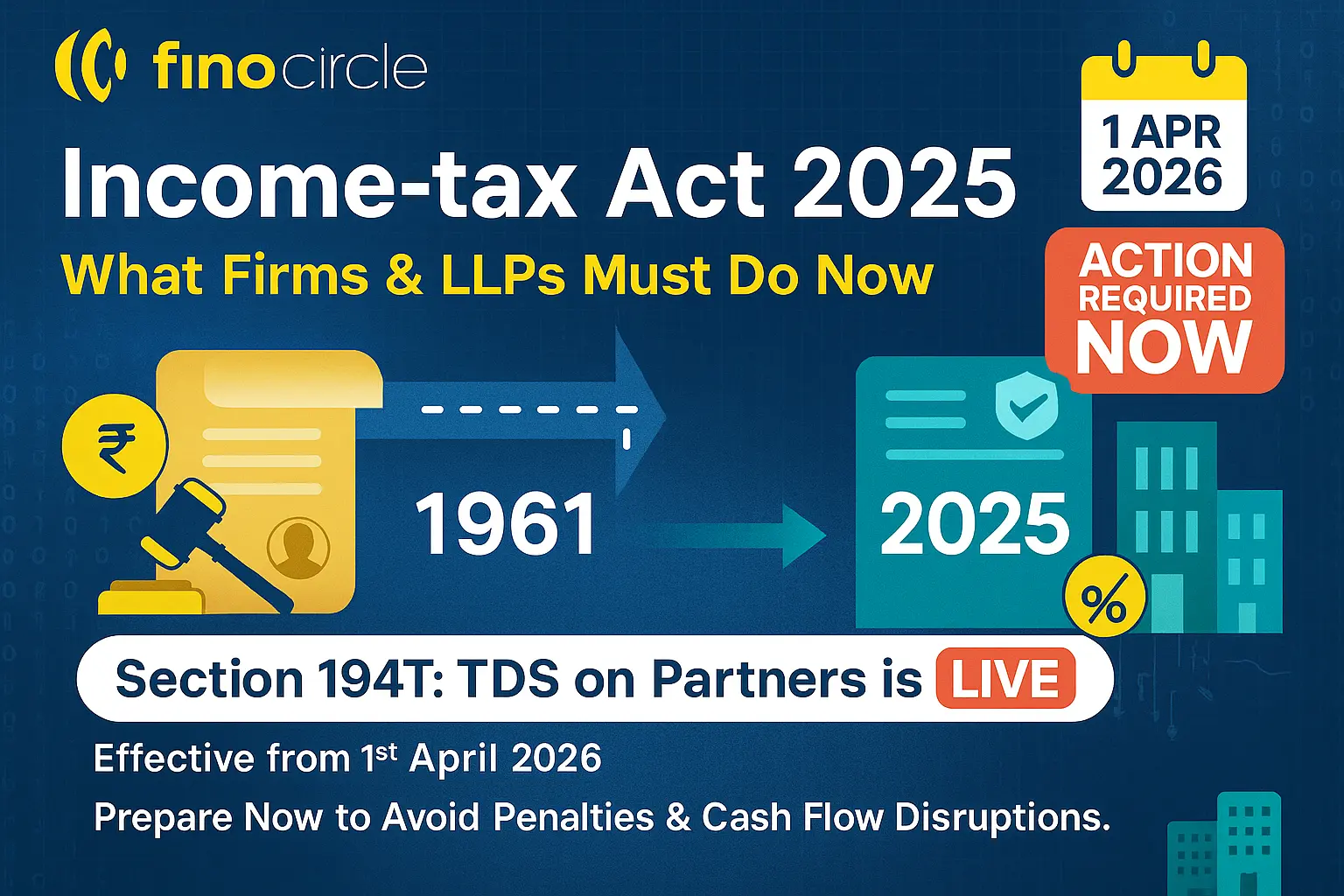
The Income Tax Act 2025 consolidates and modernizes tax provisions, ensuring clear interpretation.
ITR forms and filing utilities restructured to align with the latest Act.
The new law focuses on digital-first compliance, simplification, and reduced disputes.
The most impactful change for LLPs and partnerships is the Section 194T which is effective from April1, 2025.
This means that LLPs and firms must deduct TDS at 10 percent on payments made to partners, such as bonus, commission, remuneration, and interest on capital.
TDS applies when the total payment to a partner exceeds Rs 20,000 in a fiscal year.
Applicability:
Compliance deadlines:
Allowable deduction limits under Section 40(b) are revisited under the latest tax framework. Earlier the deductions were on book profits for partner remuneration. The disclosure and method of computation have now been simplified and may align with digital reporting under the latest ITR formats. What will be the impact on firms? Firms may face a shift in allowable deductions for the partner pay, and the firms that earlier optimized remuneration for reducing taxable income should reevaluate under the new revised scheme.
The CBDT has indicated that ITR forms will accompany the Income Tax Act 2025, and these forms will be data-aligned and simple, with fewer overlapping times, digitally verifiable, and more transparent for the LLPs.
What to expect? Fewer manual entries, more data validation, stricter verification of the partner TDS credits, as well as firm-level deductions.
Example 1: TDS Trigger
A partnership company credits Rs 25000 to Partner X as remuneration in 2025-26 and as the total exceeds Rs 20000, TDS @10% must be deducted and subsequently deposited i.e. Rs 2500.
Example 2: Cash Flow Planning
Partner Y’s remuneration Rs 50000/month
In a year, the firm should deduct Rs 60,000 TDS
Firm should factor this TDS outflow
Setting partner draw the schedules to avoid any liquidity crunch
Example 3: Partner Remuneration Limit
A company’s book profit of Rs 10 Lakh earlier allowed Rs 6.3 Lakh as deductible remuneration
According to the latest computation, this might vary, and the firm should recalculate using the updated formula available in the remuneration calculator of the Income Tax Department.
The threshold of Rs 20,000 under Section 194T may seem small at first but for most of the LLPs, this is TDS on all partner payments. As for the small and mid-sized companies, any failure to comply with this can result in-
With the Income Tax Act 2025, any mismatch between a partner’s ITR and firm deductions is automatically flagged. In other words, it is not only a rule change; it is a compliance culture shift.
When will the Income-tax Act, 2025 come into force?
As notified by the Centre, it is scheduled to come in effect from 1st April 2026.
What is Section 194T?
The 194T Section needs partnerships and LLPs to deduct 10% TDS on the payments where the aggregate payment to a partner goes above Rs 20,000 in a year, applicable from 2025-26.
Does partner remuneration remain deductible for the firm?
Yes, however, the deduction limits and computation rules are updated, and firms must recompute allowable deductions under the revised guidance.
LLPs should start reconciling partner credit entries, consult a tax advisor for agreement updates, plan cash flow, and update the accounting systems to see TDS on qualifying payments.
Therefore, if your LLP or firm pays its partners on a regular basis, you are likely already exposed to Section 194T already.
Finocircle provides a TDS readiness audit as well as partner remuneration review to help you minimize cash flow disruptions and also to avoid any penalties and interest.
Most of the LLPs underestimate Section 194T. We recommend that you start early and align bookkeeping, cash flows, and partner agreements before penalties begin to be levied. Use TDS on Partner Calculator and estimate the deductions automatically.
Book a free TDS readiness assessment with Finocircle, and the team will conduct a quick review of your 12 months of payments to provide urgent next steps. Also, you get a personalized compliance report to avoid any defaults before the latest tax law comes into effect.
