
Accounting & Financial Management
Business Registrations
Tax & Regulatory Compliance
Annual Compliance Services
About Company






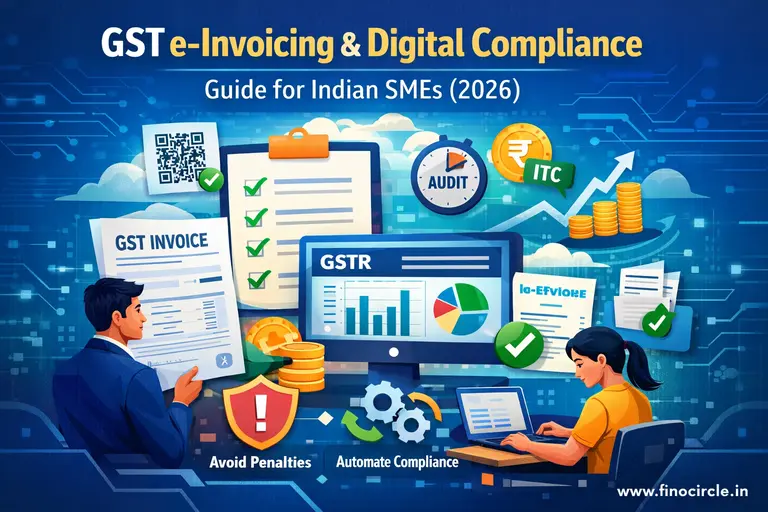
The GST ecosystem in India is now evolving at a faster rate than ever before. What started as just a tax reform is now a technology-driven compliance system, in which real-time reporting, e-invoicing, digital audit trails, and automated reconciliations are no longer options, but necessities. For SMEs in India, this shift presents both risks and opportunities.
Earlier, those who ignored GST compliance faced penalties and still do, stressful audits, and blocked ITC. But those who adopt it in regular business and smartly, they get faster payments, better cash flow visibility, cleaner books, and audit confidence.
Here, we will explain everything that Indian SMEs and businesses should know about GST e-invoicing and digital compliance in simple terms.
Over the last few years, the Indian government has strengthened GST enforcement by:
For SMEs, this simply means:
Also, businesses that adopt digital compliance are now seeking-
So, basically GST e-invoicing is the system where B2B invoices are electronically authenticated by the GST network before it is issued to the customer.
How it works?
After the validation, the invoice is then considered to be legally valid
And once the invoice is generated, the data of the invoice flows into GSTR-1, GST reconciliation tools and E way bill systems.
GST e-invoicing is compulsory for businesses that cross the prescribed annual turnover threshold that has been gradually reduced over time.
So, if your business supplies services or goods B2B, works with big corporates or government entities, and has turnover close to or above the limit, you should be e-invoice ready already even when you are not mandated, because the buyers expect compliant invoices.
Important: non-generation of the e-invoices when its applicable can make the invoices invalid and can result in penalties.
Despite the best efforts and intentions of business owners and founders, a lot of SMEs struggle with GST filings due to manual processes and fragmented systems.
Sales invoices do not align with the taxes, resulting in ITC issues and notices.
Missing invoice data or vendor non-compliance causes denial of credit.
Manual filing and tracking lead to missed deadlines and penalties.
Poor documentation and records also increase the audit time as well as cost.
There are even cash flow delays in case of non-compliant or incorrect invoices. This leads to delayed customer payments.
A good GST system is not just about doing more work; it is rather about doing less of manual work smartly.
Step 1: Use Cloud-Based Accounting Software
It is recommended that you shift away from the offline and manual spreadsheets and tools. Cloud accounting helps in real-time data access, seamless GST integration as well as automatic backups.
Step 2: Automate e-Invoice Generation
Invoices must be generated with zero manual re-entries, direct integration with GSTN, and auto IRN and QR code.
Step 3: Enable Auto GST Return Preparation
Tax data, purchases, and sales must flow directly in GSTR-1, GSTR-3, and reconciliation reports.
Step 4: Integrate Banking & Payment Data
Link the UPI and bank feeds to improve cash flow forecasting, match receipts with the invoices, and track outstanding receivables.
Step 5: Maintain Digital Audit Trails
All invoices, payments and returns must be timely stamped, stored digitally and must be easy to retrieve during the audits.
Proper GST and e-invoices help in reducing the delays and disputes, thus improving overall cash inflow.
Real-time dashboard highlights outstanding receivables, working capital position as well as upcoming taxes.
When you go with automation, it automatically cuts down audit preparations, CA back and forth, and manual data entry.
The right data also reduces the red flags in GST system.
Clean compliance makes it simpler to expand the operations, work with bigger clients and raise overall funding.
Mistake 1: Treating e-Invoicing as a One-Time Setup
As GST rules change every now and then, systems need to review regularly. Also, fix quarterly compliance checks as well as system updates.
Mistake 2: Partial Automation
Generating e-invoices but still manually reconciling? End-to-end automation is the fix from invoice to returns to bank matching.
Mistake 3: Lack of Team Training
Mistakes happen when the staff do not understand proper workflow. The best fix is periodic, short training sessions for the accounts teams.
You must ask yourself-
If you said “no” to any of these questions above, then your compliance setup requires attention.
Looking forward, GST compliance will be:
More AI-enabled
Anomaly detection, compliance insights and predictive alerts
More real-time
Less room for any post-fact corrections is possible
More integrated
Banking, tax systems, logistics and accounting systems work together
More data-driven
Automated mismatch detection
Businesses, specially SMEs that prepare well in advance face less friction as well as lower amount of risk as the regulations tighten.
Finocircle team works with SMEs, growing businesses and start-ups to simplify the GST process, digital bookkeeping, end to end financial management and accounting automation. So, from setting up the GST e-invoicing and automating returns to maintaining real-time dashboards and audit-ready books, Finocircle helps businesses to stay compliance while at the same time gaining financial clarity.
With a mix of industry expertise, hands on support and technology driven processes, Finocircle helps the business owners and founders to move away from reactive compliance and towards growth focused, proactive financial decision making.
So if you are looking to reduce the compliance stress, build future ready finance system or avoid penalties, Finocircle serves as extended finance and compliance partner.
GST e-invoicing and digital compliance are not just legal requirements anymore, they are the foundation of a scalable and strong business. With the right systems, Indian SMEs can build credibility with lenders, regulators and clients, improve financial clarity and cash flow, stay audit-ready and more.
So, the goal is not only to comply, but to be smarter.
