
Accounting & Financial Management
Business Registrations
Tax & Regulatory Compliance
Annual Compliance Services
About Company







The rapid adoption of digital transformation is driving financial digital world, reshaping the way finance and accounting people manage the core operations and provide value. Organizations are considering AI now to automate their everyday accounting tasks as well as streamline processes such as payroll and invoicing, thus reducing any errors and enhancing efficiency. A survey by Gartner shows that about 80 percent of the financial organizations actually invest in AI and accounting automation India 2025, but just 25 percent have an actual well developed strategy.
Account and finance digital transformation includes integration of technologies, enhancing accuracy, efficiency and decision making. This digital transformation includes adopting tools like cloud computing, AI, automation and blockchain to modernize the processes like invoicing, reporting, auditing, budgeting and financial forecasting.
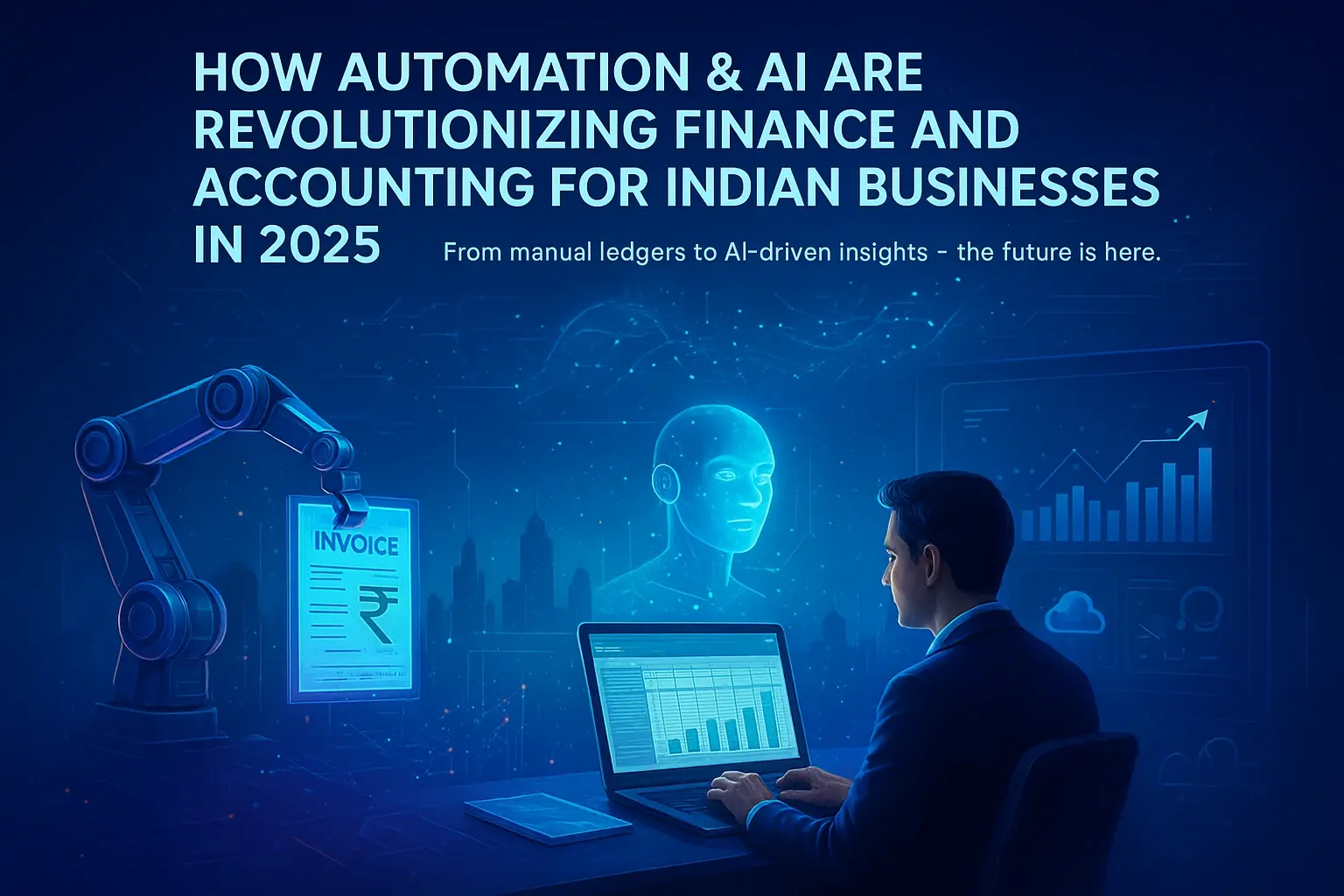
Bringing about digital chance is important when you want to be a leader in accounting and finance. The leaders/founders must focus on aligning the new technologies with goals that ensure that the teams are well equipped to manage the transformation in a smooth way. The innovative accounting software providers and solutions are now redefining the whole finance and accounting sector, introducing tools such as blockchain to secure automated tax solutions and financial transactions for better compliance and efficiency.
Integrating HR & financial operations with Cloud technology
It is seen how cloud solutions are revolutionizing the budgeting process and workforce management in finance and HR operations. Platforms such as Oracle HCM Cloud help organizations to align the financial goals with HR strategies, thus fostering efficiency.
The finance sector is using and happily embracing cloud based solutions for scalability, less operational costs as well as improved data accessibility. A 2024 report forecasts that 92% financial organizations will rely on cloud infrastructure for its core functions by the year 2026.
Blockchain for Secure Transactions
Blockchain is widely used for improving security and transparency in the financial transactions. It further facilitates fraud resistant and faster payments, along with ensuring auditability. About 60 percent financial organizations explore blockchain solutions for record keeping and transaction validation.
AI Powered Analytics For Forecasting
Oracle HCM Cloud influences AI powered workforce analytics for bridging the gap between finance and HR. through analyzing employee’s performance, workforce trends, productivity, now organizations can easily make accurate financial forecasts and also optimize resources accordingly.
Cyber security measures
With progression of digital transformation, the need for a solid cyber security becomes vital. Financial organizations are heavily investing in AI powered cyber security tools in order to safeguard sensitive information and data. AI driven cyber security solutions can help detect anomalies thus reducing data breaches by about 40 percent.
Automated GST return processing and e-invoicing for SMEs
Automated Billing system is not just helping simplify the process of GST return processing but even ensure efficiency and accuracy, especially when integrated within GST billing software. With the rapid AI and digitization revolution, the traditional invoicing practices are soon becoming obsolete. Under the latest e-invoicing system, all B2B invoices get authenticated by the GSTN electronically. And as done in the past, the businesses can continue generating invoices on the respective ERPs.
As the demand grows for digital solutions, it is vital for organizations to focus on re-skilling the teams. This includes ensuring digital proficiency in tools like AI powered analytics, cloud based reporting systems as well as automated billing processes. Nurturing continuous learning and adapting to the revolution will further prepare teams to meet the ever evolving demands of the digital first world.
Operational efficiency
Automation tools and technologies streamline the repetitive process like invoicing, compliance checks and payroll. This further reduces manual intervention, reduces errors and saves time for businesses.
Better accuracy in financial and accounts reporting
Digital tools minimize the chance of manual errors in data entry, ensures precise bookkeeping, preparation of financial papers and payroll processing. In case of finance, AI powered analytics further ensure cash flow forecasting in an accurate manner, thereby enhancing the overall decision making reliability.
Expansion of Open Banking and API Ecosystems
The open banking systems are fostering collaborative financial atmosphere by allowing the third party developers to create applications and services around financial organizations. This is further facilitated through APIs, resulting in innovative financial products as well as personalized customer experience.
Efficiency in accounting and financial operations
Automation helps to streamline the tasks such as budget planning in case of finance and reconciliation in accounting. This reduces the time spent on repetitive and time consuming tasks. It also increases the ability for strategic analysis, ensuring faster closing at the month end and also for annual report preparation.
Automation also helps to accelerate tasks like forecasting, invoicing and budgeting. It further minimizes human errors in case of serious accounting and financial operations, thus ensuring accurate reporting, streamlined workflows as well as compliance.
Increasing dependency on digital platforms sometimes raise concerns about cyber attacks and data breaches too. Financial organizations must ensure that there are robust cyber security measures in place to safeguard sensitive data of the customer as well as organization. Like a 2023 report stated that 60 percent financial organizations faced cyber security problems during the time when they were transforming to digital platforms.
Implanting latest digital technologies need substantial infrastructure investment, investment in tools as well as training. SMEs may find it tough to allocate required budget for such digital transformation.
In many cases, stakeholders and employees may also resist to adopt the new digital technologies for finance and accounting due to fear of losing their job, job displacement, lack of knowledge as well as continuing comfort level with the present processes and tools.
Choosing the right tools for GST, income tax, and payroll
The right GST software you choose will depend on various factors like the size of your business, industry as well as your organization’s specific requirements. It is very importance to choose the right tools for e invoicing solutions, GST automation for SMEs and AI driven bookkeeping.
Training teams for digital adoption
As accounting and finance teams adopt latest technologies, there is generally a gap in necessary digital skills. All this requires reskilling or upskilling programs and ensure that employees are perfect in using tools such as data analytics, blockchain and AI in tax compliance etc.
HSBC implemented the AI driven solution for detection of frauds using machine learning and to analyze any suspicious activities. This enables fast response time as well as enhanced security for the bank as well as its customers.
The traditional systems miss out on real time data analysis and there is high risk involved for fraudulent activities if there is no automated intervention. Oracle HCM Cloud offers the predictive analysis and AI features that can be leveraged by HSBC to enhance employee training program on cyber security, thus improving operational efficiencies. This will further provide real time insights for better fraud detection.
BUNQ is the first European bank that made a profit in 2023 and earned 53.2 million Euros. The bank started using AI as well as machine learning in the year 2018 for tracking of transactions and to prevent any money laundering. And for the least 2 years, Bunq has even used AI platform by NVIDIA to detect any frauds. This checks 520 things about every payment made. And includes the payment time, how fast the information was entered as well as the amount being sent. This further helps them to figure out whether the transaction is real.
The future of digital automation in finance and accounting is expected to redefine the traditional processes. When automation becomes integrated in financial systems, daily tasks such as invoice processing, finance reporting and data entry is streamlined through robotics process and AI automation. AI and automation are revolutionizing finance and accounting for Indian businesses and will reduce risks of human errors, allowing finance and accounting teams to put focus on strategic planning and stop the manual tasks.
With all these advancements and a lot more coming every single hour, the future of finance and accounting also demands more elite cyber security measures. As the digital tools become well integrated into financial ecosystem, the risk of cyber attacks and data breaches grow, necessitating solid encryption methods, multifactor authentication as well as AI driven threat detection.
Together, these digital advancements will shape a future where finance and accounting functions are more transparent, secure, efficient, and strategically aligned with business goals.
The business advantages of early tech adoption
Early adoption facilitates businesses to stay updated and relevant. It further provides organizations a competitive edge. As per the PwC Payments 2025 & beyond report, 6 macro trends affect the future of payments- digital currencies, cross border payments, financial crimes, inclusion and trust, digital wallets, battle of rails. The startups should pay attention to the latest trends as they require investment in latest technologies. Also, the payment processing firms should define their early adoption strategies to benefit from the market realities and further ensure future success.
If you are seeing yourself falling behind the digital bandwagon or want to include the digital automation in your systems, Finocircle stands out at the leading corporate solution provider, offering various services and solutions for digitized financial and accounting systems. With a wide team of certified and equipped tools and professionals, Finocircle helps organizations identify their gaps and ensure that you adopt the latest AI tools and steps to improve your cyber security, data science and methodologies in the fast changing and evolving digital finance and accounting sectors.
Also, Finocircle is there to help executives with strategic insights that they need to navigate the business challenges in a more confident and updated manner. To drive longer lasting success in finance and accounting, organizations must emphasize on upskilling in the areas like e-invoicing, cyber security, GST, tax compliance automation and more.
What is DIGITAL revolution in finance and accounting?
Digital transformation in finance and accounting is the integration of technologies like data analytics, AI, blockchain and automation in financial operations.
What are the key challenges organizations faces?
Challenges involve resistance to changes, considerable investment in latest technologies, concerns about data security, integration with the legacy systems etc.
What role does automation play for finance and accounting?
Automation in digital revolution reduces the manual tasks like reporting, invoice processing and more, thus freeing up the resources for better decision making and also improving operational accuracy and efficiency.
Why is upskilling important for finance and accounting teams?
Upselling plays an essential role in keeping the finance teams updated with digital technologies and tools, ensuring that they can adapt to the new workflows, stay complaint with new regulations as well as manage data efficiently.
