
Accounting & Financial Management
Business Registrations
Tax & Regulatory Compliance
Annual Compliance Services
About Company






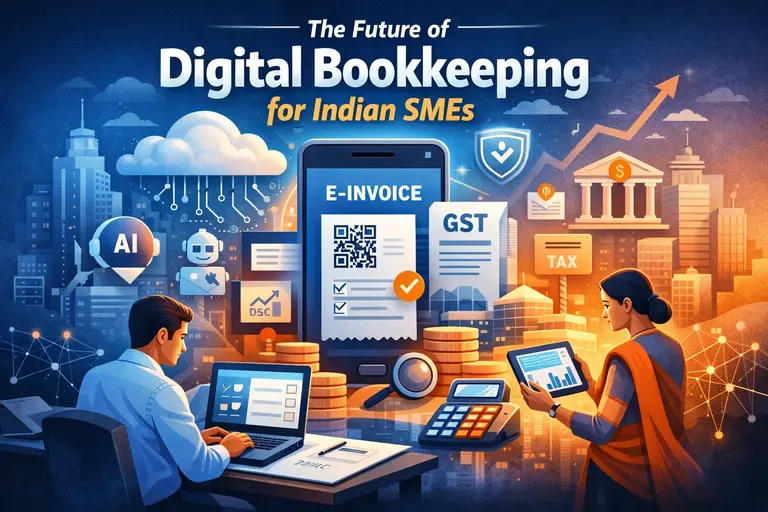
Now, digital bookkeeping for Indian SMEs is shifting from spreadsheets to cloud systems that are powered by AI and automation. The regulatory drivers, including updated company and income tax rules, mandatory e-invoicing, digital signatures, and the government’s push for digitization, necessitate that SMEs adopt e-invoicing, real-time record management, and compliant cloud accounting to remain audit-ready as well as competitive.
Regulatory enforcement is increasing across the board, including digital filing requirements and e-invoicing thresholds. Non-compliance risks, fines, audit headaches, and GST mismatches are also on the rise.
Cloud, APIs, AI, and other technologies are now making bookkeeping cost-effective, faster, and accurate for micro and small companies.
Vendors and customers expect to receive digital invoices, which leads to seamless payments and fast reconciliations, and thus, digital bookkeeping serves as a commercial advantage.
It has been observed that the government has progressively lowered the overall turnover threshold for e-invoicing. Currently, e-invoicing is required for businesses with an aggregate turnover of INR 5 crore or more in the previous year, and systems for uploading invoices, along with IRP rules, make digital invoice generation crucial for many SMEs. Failure to comply with this leads to GST reconciliation issues and risks of ITC denial.
MCA has further issued notifications and amendments clarifying that digital attachments, certifications, and e-filing affect the statutory books, annual filings, and board minutes of companies to maintain records for validated audit trails and digital documents. SMEs that are structured as private limited firms need to align with the updated e-document rules of MCA.
The Finance Acts (income tax law updates), as well as administrative guidance, assume the digitally maintained records and offer a framework for data retrieval and tax audits. The tax officers rely on these digital trails as being audit-ready, with proper ledgers, which reduces the risk involved.
Aadhaar-based eSign and DSC services are now widely used, and businesses should ensure that they have legally valid sign-off processes for contracts and filings. Always check the MCA as well as tax e-filing support for attachments and accepted formats.
There is a rapid advancement in technology now than ever before.
Cloud accounting software, such as TallyPrime Cloud, Zoho Books, and QuickBooks, moves bookkeeping from local files to synced ledgers.
AI and ML are utilized for automated OCR of bills, anomaly detection, financial forecasting, and smart categorization.
Interoperability with e-invoicing and GST IRP portals – Accounting platforms should integrate to generate QR and IRN codes automatically.
Accounting process, filing practices, pain points, inventory tools, last GST filings, reconciliation time, person responsible, etc. – all these factors should be assessed properly.
Choose a vendor that supports GST compliance, bank feeds, e-invoicing integration and has a good reputation in the market.
Export the ledger balances, GST returns and reconciled statements into new system and maintain backup copies as well.
Ensure that you configure automatic IRN generation, reconciliation routines, and GST return mapping. Further, train the billing team on any mandatory fields.
Connect the UPI feeds/bank feeds, enable the auto-matching rules, and set the tolerance expectations for review.
Use the automated capture option and verify your inputs automatically. This reduces the data entry errors.
Ensure that there is proper segregation of duties, such as approval, reconciliation, and billing, and maintain digital audit logs for tax scrutiny and MCA purposes.
The short-term cash flow forecasting, margin analytics, and overdue receivable alerts should be added.
Use the approved DSC vendors, data residency compliance, and secured backups if needed.
Some suggested tool categories include ZohoBooks, Tally cloud variants, QuickBooks etc. E-invoicing middleware is necessary when there are high volumes of invoices, and reconciliation tools and expense management apps are also required.
Q: How to know if e-invoicing is mandatory for my SME?
A: if the aggregate turnover crosses the applicable threshold, then e-invoicing is required. Always check the turnover history and consult the GST portal for exact dates.
Q: Can I use digital signatures for MCA & tax filings?
A: Yes, DSCs and eSign are accepted in many filings, but you have to ensure that the certificates are issued by approved Certifying Authorities and the attachments comply with MCA formats.
Q: What is the cost of digital bookeeping?
A: Costs vary largely by scale: micro-SMEs can start with the low-cost cloud plans; mid-sized firms may require ERP integrations. Always evaluate the monthly subscription, implementation, and training.
Digital bookkeeping is not just an option for Indian SMEs. Improved technology, clear business benefits, and regulatory drivers mean the adoption of integrated cloud bookkeeping is the fastest way to achieve compliance, operational resilience, and improved cash flow. The Finocircle team helps SMEs choose the right software stack, ensure statutory compliance, and implement e-invoicing workflows, allowing business owners/founders to focus solely on growth, rather than reconciliations.
